

Let’s be honest, writing is for authors, scholars, and the like. Specifically, when we look into the writing tasks in IELTS, whether it is IELTS writing for academics or IELTS writing for general training, we all have at least once muttered, “How on God’s green earth am I supposed to write all this in an HOUR?”
We hear you. That is precisely why we – us and you- are here. As an IELTS instructor for 3 years and probably the biggest hater of IELTS Writing, I have taken it upon myself to advise you on the easiest, laziest way to conquer your fears and limitations for everything that comes your way in IELTS Writing.
So, sit back, grab a glass of water (hydration is King), and take notes, kids. Let’s get into it.
What you’ll need:
- Attention (I’ll elaborate in a minute)
- Imagination (because, of course!)
- Patience
IELTS Writing, depending on whether you’re appearing for academic (meaning your goals are to migrate for study purposes) or General Training (work, PR, etc.), can be more or less forgiving.
Remember: all the information you need is already in front of you. You only need to analyze and interpret it in your way.
IELTS Writing overview:
This module requires you to finish two tasks.
- IELTS Writing Task 1 (150 words min. regardless of Academic or General)
- IELTS Writing Task 2 (250 words minimum, common for both Academic and General)
IELTS Writing separates Academic and General only for their Task 1. Here is how:
- Academic:
You will write (obviously) 150 words based on a VISUAL REPRESENTATION. These include:
- Graphs (bar, column, line, etc.)
- Charts
- Pie-charts
- Diagrams
- Illustrations
- Sometimes, tables
Note: There could be more than one figure given in a single question, sometimes called a combination (for instance, a pie chart and a table both could be given)
Your task is to look at whatever figure(s) are provided, and write a minimum of 150 words based on them. To do so, you shall:
- Point out the most obvious features (highest, lowest, most significant, etc.)
- Make comparisons
- Derive conclusions
- General Writing:
You will write a letter in a minimum of 150 words, in the question you will be provided with:
- To whom are you writing the letter? (receiver)
- Why you’re writing the letter (purpose)
- What you have to mention in the letter (subpoints)
Your only job is to weave a story covering all of these points. Best part? No need to worry about the format (date, address, indentation, etc.) as you will begin the letter with Dear Sir/Madam/Name
Now, the real question: What can be done about Task 2? Let me assist:
Understand this: no templates will help you. It is easier to understand the format of an essay than to memorize templates (which are penalized in the exam anyway).
So, here’s what a normal format for an essay looks like: it is divided into a minimum of 3 segments:
- Introduction paragraph
- Content (Body paragraphs: each discussing 2-3 points)
- Conclusion
Normally, there are two body paragraphs in an IELTS writing Task 2 essay; thus, the format looks something like this:
- Introduction
- Body Para 1
- Body Para 2
- Conclusion
Remember: All your points/ideas/content shall remain in the body paragraphs. The introduction segment does not discuss any points, while in the conclusion paragraph, you cannot introduce or discuss any new points. This is an IELTS Essay made simple.
- Read and understand the question: what the topic is and what is specifically asked of you.
For instance: “Obesity is a problem prevalent in modern children. What are the reasons for this, and what solutions can be offered?”
Here:
- “Obesity is a problem prevalent in modern children” is called the Background Statement. This is the part of the question that gives us context.
- “What are the reasons for this and what solutions can be offered?” is the Problem/Question statement. This part of the question gives us clear instructions on what we have to do. Here we have to list the reasons and solutions for the situation that was given to us by the background statement.
- However, if instead of “reasons and solutions” the phrase had been “what are the problems caused due to this and what solutions can be offered”, the instruction changes. Now, we don’t have to list reasons, but the problems that COULD be caused due to children’s obesity in the foreseeable FUTURE.
- This is why it is important to spend at least 2 minutes to properly read and understand the question itself.
- Spend 5-7 minutes listing out the points/ideas
- Once you have properly understood the core topic of the question and what EXACTLY it is that you’re supposed to write, we move to the next part: planning and troubleshooting
- In this step, you will not write a single word of the essay yet. Instead, you will mentally or physically construct a table or a list of points, no longer than 2-3 words, just to give yourself a starting point for each point.
- Let’s get specific: The question we are discussing has asked us to provide two things: reasons and solutions. Therefore, it becomes tremendously easy for me to PLAN my points in such a way that,
- Introduction
- Body Para 1 (Reasons)
- Body Para 2 (Solutions)
- Conclusion
Fret not, specific, working, proven formats for introduction and conclusory paragraphs exist as well, which I will provide towards the end.
For now, let’s focus on “Cataloguing” our points, we need 2-3 per body para, including examples:
- Reasons for obesity in children. This should be easy:
- Unhealthy diet
- Lack of physical activity
- Genetic/Medical conditions
- Now, the solutions can easily be derived from the reasons we have already mentioned:
- Parental control on diet and awareness about healthy food habits
- Encouragement to participate in extra-curricular activities that provide physical exercise, such as sports
- Medication, naturopathy, yoga, and other forms of therapies
Notice that the solutions themselves reflect the same order as the reasons:
- Diet reason -> Diet solution
- Physical activity reason -> Sports
- Medical/Genetic issues -> Medication/Naturopathy/Therapies
So, overall…..
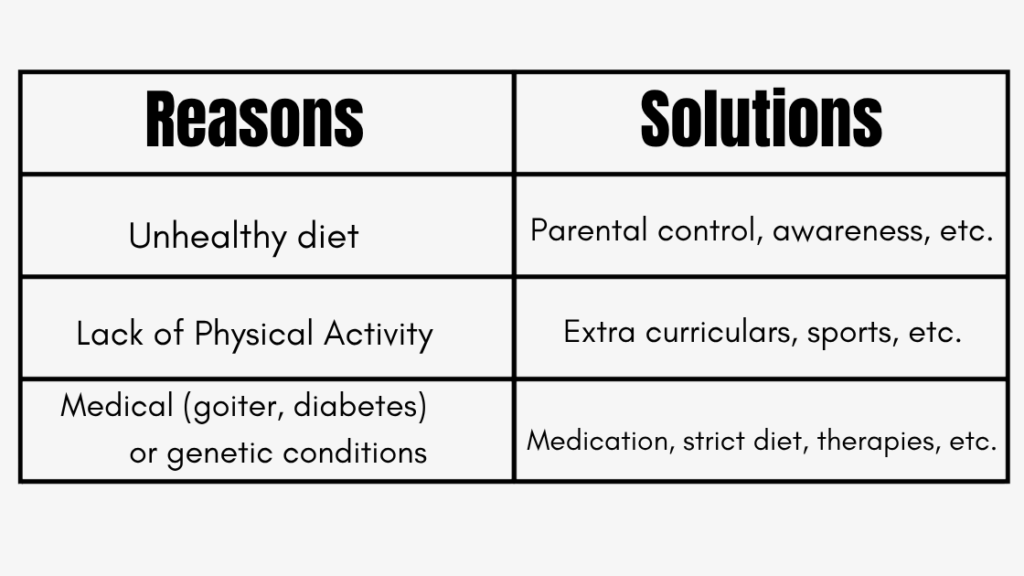
Now, we can easily plot our actual points. We do have to be smart about it, as directly writing the points from the table is not efficient. For instance, “Unhealthy diet” doesn’t explain as much as it confuses. We have to make sure our trail is crystal clear.
This is what I mean:
- Unhealthy diet: Children eat junk food -> Reason being tough economy, thus parents sometimes both working professionals -> Not enough time for home-cooked meals -> Rather, the children eat something from a restaurant than them starving.
– Notice we gave a full explanation as to WHY this is happening, without blaming the parents or children themselves. We explained the situation.
- Lack of physical activity: Children don’t go out to play much -> constant 6-7 hours of school in the morning -> competitive studies so at least 3-4 hours of extra tutoring right after school -> finishing up tasks and homework and extra assignments -> 9 pm already, with literal physical and mental exhaustion, they obviously wouldn’t want to go outside and “play” by this point. Additionally, all entertainment, social life, etc., exists on technology (smartphone, online games, chatrooms, etc.), so the allure of “Playing with friends” does not work anymore.
- Medical/genetic conditions: Some people are born with a higher content of fat, while some face problems like inherited diabetes or thyroid issues, where either the problem or its medication can cause the child to gain weight as a symptom or side effect.
I do not say that this is how detailed you have to be. I’m merely articulating the best version. You will decide and pick and choose which parts to keep, but you can only do so once you’ve fully understood what you are writing. This is why the Planning stage is crucial.
Next, you will do the same with solutions, and only after you’ve reached 100% understanding of your table/points/topic, then and only then will you begin writing.
Introduction: 3 statements.
- General statement about the overall topic
- Paraphrase the Background Statement itself
- Address the Question statement.
Here’s an example:
The modern lifestyle has proven to be both progressive and problematic for humans, especially children (General Statement). In today’s era, young kids often face physical difficulties, the most common of which is excessive weight and fat gain, also called obesity (Paraphrasing the BG statement). In the following essay, I shall provide valid reasons and try to offer possible solutions for it. (Address and answer the question statement itself.)
All said and done, the IELTS Writing test checks your ability to communicate in a written manner. This includes summarizing, specifying, explaining, organizing, etc. Keep your tasks simple, readable, and organized. The bands will follow.
Hope this helps!