

PTE Academic is a computer-based test of English. It is designed to measure the academic English abilities of candidates who wish to demonstrate their level of achievement to professional and government organizations and education institutions.
Like any other English Proficiency Test, PTE is also consist of four modules.
Such as Speaking & Writing (first part)
Reading (second part)
Listening (third part)
Speaking
In this Blog, we are going to discuss what are the tips, tricks and methodology needed to crack all these modules.
So, before we dive into detailed question types, let’s understand what the Speaking Module is all about?
First, we should know that what are the Skills which are assessed in speaking module,
- Content and cohesion
- Oral fluency
- Pronunciation (including stress and intonation)
- Lexical resources (vocabulary range)
How to Prepare for the Speaking Section?
- The first pre-requisite for good speaking skills is the habit of speaking, not only in the academic but also in the social contexts. If you move around in company where any particular language is spoken as a matter of course, it does not need much time to pick up the spoken language, right?
- But, for the purpose of PTE (Academic), the speaking ability has to be structured and focused on answering exactly what is asked. This needs the ability to comprehend first the context, then the question. The context could be listening based, or reading based. So, the need is to read or listen and understand. The question is what will separate the grain from the chaff. Comprehending the question will build focus on such part of the context as is needed.
- The next step is to familiarize yourself with all the question types that occur in PTE (Academic) so that strategies to respond to each question type could be worked out and practiced well in advance.
General Tips for the Speaking Section
- Adjust the volume of the headphones to your own convenience such that neither your voice hurts your ears, nor others’ voices disturb you.
- Speak at natural pace, at normal volume (neither too quietly nor too quickly), and with natural accent. There is no need to imitate or be inclined to use any unnatural, or so-called native accent.
- All of us commit slip of the tongue. It is alright if you miss out on something or commit a minor error while speaking. Carry on as usual. There is really no need to correct or repeat yourself.
- It is important to keep speaking even if it is only to make a sound or buy time. In long answer type questions, keep saying something while you formulate your ideas. The fillers could be like “Yes, I would say”; “Shall we say?” Remember – No sound for 3 seconds means recorder gets off
- Take note of the “Time Remaining” at the top right-hand corner and “Next” button at the bottom right-hand corner. You know how much time you are left with to record (this time is controlled by the computer), and, after you complete your answer, you know you need to rush to the next question without losing time.
General Tips for Maximizing Score in Speaking (Pronunciation and Fluency)
- Let the accent not affect your pronunciation. Don’t lose the pronunciation in order to get accent.
- Continuity is more important than speed. Don’t halt or revise in parts.
Now we will discuss each question type in detail
Personal introduction
In this section, you are given a prompt and are asked to introduce yourself orally. You speak about yourself for up to 30 seconds. This is not assessed but is sent to institutions along with your score report.
The Personal Introduction section is not scored. The purpose of this section is to give you an opportunity to show admissions officers a little about your personality. Additionally, it is used to verify your identity by the institutions that receive your scores.
First, you will be given 25 seconds to read the prompt. Then, you will have 30 seconds to respond. An on-screen status box will let you know when to begin recording, how much time remains, and when the recording time is up. You cannot re-record your Personal Introduction.
TIPS
- Remember that your goal for this section is to make a positive impression on the admissions officers.
- Be prepared. You should know what you are going to say before you arrive at the testing centre.
- Practice what you intend to say in front of a mirror. If you can, record yourself and listen to your delivery. Does it sound natural? Are you conveying the impression you want? Keep practicing until you feel completely confident about what you will say. You will not be able to read a prepared speech, but if you have practiced what you want to say, you will sound confident and natural. Relax, speak clearly, and avoid sounding as if you have memorized a speech. Your aim should be to sound naturally confident, not rehearsed.
- You will have 30 seconds to record your Personal Introduction. Be sure your speech lasts the required length of time. If it does not, then either you will run out of time while you are still speaking, or you will finish too soon, and have to sit in uncomfortable silence until the recording ends.
- Read Aloud
In this section, you are given a text (up to 60 – 65 words) and are asked to read the text aloud. You do six to seven of these items, depending on the combination of items in your test.
Tips for Read Aloud
- About 30-40 seconds time is allowed to pre-read. Use this time to pre-read the text and to sound yourself out on words you might find difficult to handle. After this time, there will be a little tone rather say beep sound to indicate time to stare recording.
- Try to follow the flow of the sentence complete with the pauses and the emphases. The punctuation marks and theme words tell you where to pause and what to emphasize. Recognize and follow the punctuation marks but don’t name them.
- Sound natural for the intended character. You don’t need to raise the pitch of your voice excessively or speak in hush-hush tone.
- ‘Read aloud’ assignment assesses your oral fluency, pronunciation and intonation as per flow of the text. Place yourself in the shoes of the speaker and speak as you would expect him/her to speak.
- Divide the text into groups of words or phrases and then read them phrase by phrase.
- Stress on the key syllables in a theme word, speaking them in a slightly louder tone called rising intonation.
- Don’t stop speaking in between.
- Speak as soon as you hear a tone prompting you to speak.
Tips for Maximizing Score (Content)
As per PTE guidelines: “Each replacement, omission or insertion of a word counts as one error”. So,
- Do not try to explain, add, or treat anything as unnecessary.
- Do not name punctuation marks.
For Example,
“Nothing has changed the fundamental economics of business,” says James E. Copeland. “It’s still good to have a lot of capital. It’s still good to be big. But it’s still good not to let your bigness make you slow. It’s still good to stay nimble in the marketplace.”
Answer with Proper Intonation/Pauses in the Sentence
“Nothing has changed the fundamental economics of business,” (short pause) says (short pause) James E. Copeland. (Long pause) “It’s still good (high intonation) to have a lot of capital. (Long pause) It’s still good (high intonation) to be big. (Long pause) But (short pause) it’s still good not (high intonation) to let your bigness make you slow. (Long pause) It’s still good (high intonation) to stay nimble in the marketplace.”
- Repeat Sentence
There are generally 10-12 questions based on this question type.
Tips for Repeat Sentence
- Recording of one sentence at a time is played. Typically, these are short sentences.
- Listen to the sentence attentively and try to repeat as many words in order as possible.
- It helps to split the sentence into parts and repeat them in the same sequence.
- While listening, visualize the speaker and the context; focus on general sense of the sentence.
- Don’t be overly worried if a word or two is missed. The important thing is to convey the general idea in the same manner in which the original speaker did.
- Speak in a relaxed manner copying the stresses and the intonation pattern as you heard in the recording.
- Don’t stop speaking as the microphone will close after 3 seconds of silence.
- Start speaking when the status on the screen changes to Recording.
- ‘Repeat sentence’ assignment assesses your oral fluency, pronunciation and intonation.
Tips for Maximizing Score (Content)
As per the PTE guidelines, only the following are counted as errors in content:
“Errors in content means replacements, omissions and insertions only “
Hesitations, filled or unfilled pauses, leading or trailing material are ignored in the scoring of content.”
- 3/3 marks awarded if all words from the prompt are repeated in the correct sequence.
- 2/3 marks awarded if at least 50% words from the prompt are repeated in the correct sequence.
Tip: Even if you forger a word or two, you will still gee 2 marks our of 3, But the sequence needs to be correct. So, try to repeat as many words in order as possible
- DESCRIBE IMAGE
The purpose of this task is to assess your ability to describe an image related to an academic theme drawn from the humanities, natural sciences, or social sciences. Only speaking skills are assessed. You will see an image (a graph, picture, map, chart, or table). You will have 25 seconds to study the image. When you hear the tone, you should begin describing in detail what is shown in the image. You will have 40 seconds to give your response. There are six or seven images.
TIPS
- Identify the type of image. Is it a graph, picture, map, chart, or table? The approach for handling each image type is slightly different.
- Take notes if you need to. Use the Erasable Booklet and pen provided. Do not write full sentences; briefly list any important features you see.
- For graphs, charts, and tables, be sure you understand what is being measured and in what units it is being reported.
- Try to determine what the main point of the image is. You should be able to answer the question,
What is the image mainly showing?
- Maps and pictures will often have obvious features highlighted. Use words and phrases that describe the locations of features within the image, for example, on the left right, next to, above, below, and so on. If objects are particular colours, these may help you identify them, for example, the countries marked in yellow. The same is true for sizes and shapes, for example, the large square, the smaller circle.
- Graphs, charts, and tables often show trends or changes. Use words and phrases that describe the trend or movement. For example, increase, decrease, rise, fall, remain stable/steady, and so on. Use phrases to describe the speed at which the changes happen, for example, a sudden increase, a slow decline.
- Pie charts show proportions. The size of the “slices” indicates the relative size of whatever is being measured or counted. The actual numerical values for the slices are usually provided. Be sure to mention these values. If the slices are equally sized, say so, using words and phrases such as equal, the same, about the same, similar. If the slices are different – the usual case- use comparatives and superlatives to describe them, for example, the smaller of the two export categories, the largest group of people, the most popular option, the least common answer, and so on.
- For all graphs, charts, and tables, look for a pair of extreme values – for example, the highest and lowest, the largest and smallest, the most expensive and cheapest – identify them by name and describe them using the values for their measures or counts.
- While you are speaking, if you lose your train of thought, or find yourself at a loss for words, do not remain silent. The microphone turns off automatically if there is no sound for three seconds. If you need to pause to think or check your notes, use pause fillers such as um, uh, let me see, and so on. Saying something or anything is better than saying nothing because once the microphone turns off, you cannot turn it on again.
‘Describe Image’ Means Doing Three Things
- Selecting: Means choosing a few and leaving out a lot
- Reporting: Saying what you see
- Comparing: Not just about more or less
While describing an image, especially picture-based, it pays to keep a good stock of phrases handy to use while speaking. However, this does not mean chat you should limit yourself to these only. You may introduce your own as well. In a way, they help you by telling you what co speak about, so that you don’t stop speaking. Some of the common words which you may use are:
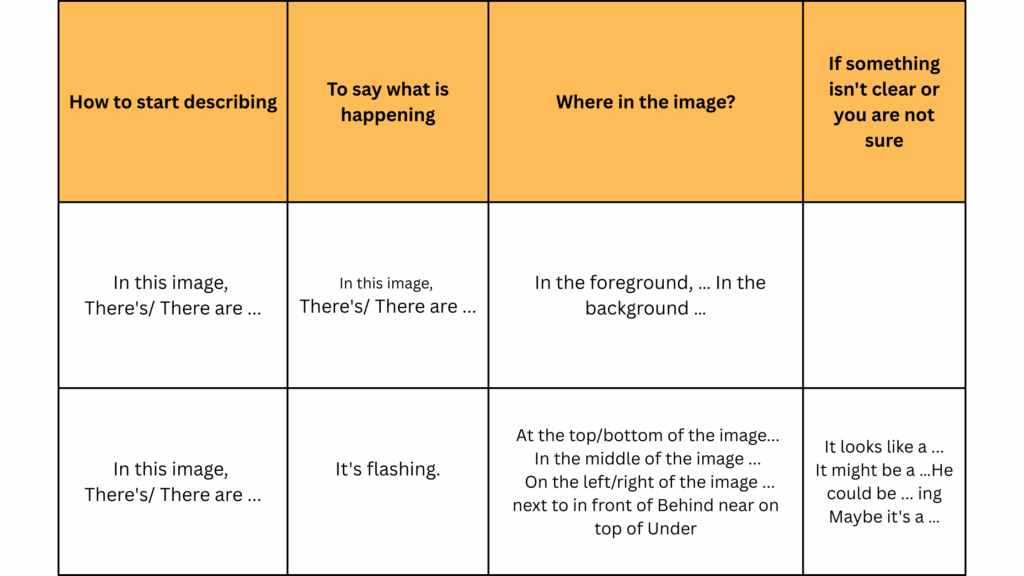
Tips for Describe Image
- You just have 35-40 seconds to ‘recognize’ the image or rather the salient features of the image. So, better organize your thoughts or impressions of the image.
- Identify and name, the type of image (line graph, bar graph, cable, chart, map, ere.), as well as the headings, labels and axes.
- Identify ‘what’ (main point). Do not simply repeat the information.
- Identify ‘wither’ (trend) or ‘how’ (comparison of entities, as proportions in a pie chart).
- Identify exceptions (highest, lowest values).
- Organize your speech into general content, main idea and conclusion/implications after making notes.
- Don’t stop speaking as the microphone will close after 3 seconds of silence.
- Speak when you hear a tone prompting you co speak.
Tips for Maximizing Score (Content)
To get a score of 5 out of 5, describe
- All elements of the image.
- Their relationships, possible development.
- Conclusion or implications.
- RE-TELL LECTURE
The purpose of this section is to assess your ability to make an oral presentation based on information taken from an academic lecture. Both speaking and listening skills are assessed. You will listen to a lecture on an academic topic and then retell what you have heard in your own words. The lectures are each between 60 and 90 seconds long. There are either three or four lectures; the number will depend on which form of the PTE Academic you are given. There will always be at least three lectures. You will have 40 seconds to retell each lecture.
TIPS
- Study the picture if there is one. It will give you a general idea about the context of the lecture. From the picture, try to predict what the lecture will be about. You will have three seconds to get ready for the start of the lecture.
- Take notes. Use the Erasable Booklet and pen provided. Do not try to write down every word you hear. Unless you are able to write quickly and accurately, you will probably fall behind and miss important information. Instead, focus on key words.
- Writing quickly is a key skill to master. Use abbreviations whenever possible. Ignore articles (e.g., a, an, the) unless they are necessary. Omitting the vowels from words is one way to increase writing speed.
- Key words include names, numbers, dates, times, and words and phrases that are stressed. Words and phrases that are repeated are usually central to the main idea.
- Focus on understanding the main idea of the lecture and the key points that support it. If the speaker draws a conclusion, be sure you have identified it. ‘Try to identify the overall purpose of the lecture.
- Listen for clues to the speaker’s attitude, opinion, or stance. Be aware of the speaker’s tone of voice and delivery, and try to detect any emotions that are being conveyed.
- When the lecture ends, you will have approximately 10 seconds to review your notes. Use this time to organize what you will say. When you hear the tone, begin speaking. You will have 40 seconds to complete the task.
- While you are speaking, if you lose your train of thought, or find yourself at a loss for words, do not remain silent. The microphone turns off automatically if there is no sound for three seconds. If you need to pause to think or to check your notes, use pause fillers such as um, uh, let me see, and so on. As said earlier that saying something or anything is better than saying nothing because once the microphone turns off, you cannot turn it on again.
- Answer Short Question
Tips for Answer Short Question
- These are usually straightforward questions but often involve visual clue.
- The clue words – who, what, when, how; or which (of these) – often help.
- Answer in one word (or two) or a phrase.
- You have 10 seconds to record your answer, but start immediately if only to make a sound.
- No credit for part answers or words incorrectly spelled.
- There is no extra mark for additional words; so, keep yourself accurate and concise.
- Start speaking when the status on the screen changes to Recording. There is no tone for this item type; so, you should start speaking as soon as you see the changed status.
- Summarize Group Discussion (Academic)
In this task, you will listen to a group discussion involving three speakers, with the audio lasting approximately 3 minutes. After the audio concludes, there is a 10-second preparation time, during which you should mentally organize their notes. The final response should be spoken within 2 minutes. Both speaking and listening skills are assessed
Tips
- Divide your erasable notebook into three equal sections:
- Label them S1, S2, and S3
- Each section corresponds to one speaker
- Write notes inside the appropriate sections as each speaker talks:
- Use S1 for Speaker 1
- Use S2 for Speaker 2
- Use S3 for Speaker 3
- Effective note-taking strategy: Follow the “5-second listen, 5-second write” rule (borrowed from the Retell Lecture task). Aim to capture as many phrases or short sentences as possible. The more you write, the better your coverage will be.
- Identify agreement or disagreement between speakers:
- For example: “S1 agrees with S2” or “S2 disagrees with S3”
- Maintain a logical flow and order when you speak.
- Speak continuously with rhythm. Avoid fumbles or hesitation. Let your speech flow naturally.
- If you misinterpret any part, do not stop or correct yourself. Continue confidently.
- Avoid speaking for less than 60 seconds, as it may negatively impact your content score.
- Respond to Situation
This task requires a fast response to a given situation. Only speaking skills are assessed. Once the question appears, an audio will transcribe it aloud. This typically takes 12-15 seconds but may extend to 25 seconds if the audio is slower. After the audio finishes, you’ll have 20 additional seconds to prepare before you hear a beep sound indicating to start speaking. You will have 40 seconds to respond
Tips
- Quickly skim the question-aim to understand the main idea within 5 seconds without reading every word.
- Draft 3 sentences using key terms you noticed. If you can manage 5-6 sentences, that’s even better.
- Ensure your speaking style matches the tone used in the read-aloud section without fumbles
- Remember Fluency is the main priority in entire speaking module.